A Super Goal is All You Need
Motivation fades. Tracking doesn't. I built an activity tracker to solve my consistency problem — and discovered that a single 'super goal' framework ties everything together.
21 June 2026
[Harley tries to calm Tony, who is having a panic attack.]
Harley: You’re a mechanic, right?
Tony: Right.
Harley: You said so.
Tony: Yes, I did.
Harley: Why don’t you just build something?
[Tony settles down, then realizes what he has to do.]
Tony: Okay. Thanks, kid.
The above is an excerpt from the Iron Man 3 movie, and I convinced myself to handle my problems similarly. I am a computer scientist who builds technology depending on my issues and requirements.
What were the problems?
I struggled to build a habit of programming, writing, and going to the gym. You might have wondered what the issue was. I could, for example, go to the gym for two months straight, and then something would happen, such as traveling to some place where I don’t go to the gym, and I stopped. Consistency was the main issue. At first, I thought motivation was the issue; as such, I will watch motivational gym videos, which might boost that feeling of going to the gym. This will only last a month or two, and then I stop.
I realized motivation is not the right fuel for accomplishing my gym goal. Instead, I started rephrasing the goal: spend a minimum of 30 minutes at the gym and go twice a week to the gym. This proved to work because 30 minutes was manageable. What works for me is focusing on the time spent at the gym rather than thinking of the program or exercises I will do there. This may work for you, too.
The other problem I had was keeping track of the activities associated with the goals I set. For example, at the end of each year, I will have an audit of how many times I have gone to the gym.
This was often a problem because I had goals in various life categories and sometimes needed to remember how many activities were done per goal. As such, it would be hard to know where to direct my path for the subsequent year or for that particular life category.
Having these problems, I knew I would not be able to reach abundance in the specific area of my life, as this proverb states: A slack hand causes poverty, but the hand of the diligent makes rich (Proverbs 10:4).
I needed a way to keep myself diligently aiming at my goals and knowing what I should exclude from my daily life, preventing me from reaching my goals.
A computer scientist approaches problems by analyzing the requirements, and these were the requirements I had extracted from my problems:
I need a system to track my goals
I need a system to audit the activities associated with my goals
I have to be diligent and consistent
Hence, the idea to create an application that will satisfy all of the above requirements so that using it will allow me to:
have something to write about
have something to program
have something to track
If I have something to track, I have something to learn about my behavior and different habits. This will facilitate seeing the problem as such and provide a solution.
It is good to start analyzing your problems more abstractly. After all, the issues are affecting you primarily, and so will the solution.
The solution: Activity Tracker Application
I have been writing about the Activity Tracker Application—you can read more about it here—and using it for the past three months. This is by far the best application I have ever created. This is not in terms of design which I currently suck at but in terms of functionality. It comes at a great time, as I have been promoted to the tech lead position and used it for work and personal life.
The activity tracker application tracks my goals and their activities. I have added more functionalities, such as a to-do list that captures the steps required for each activity and a task functionality that will become an activity in the future, to capture some ideas regarding a goal or a future activity.
This is a list of goals in my personal life whose activities I am tracking:
Press enter or click to view image in full size
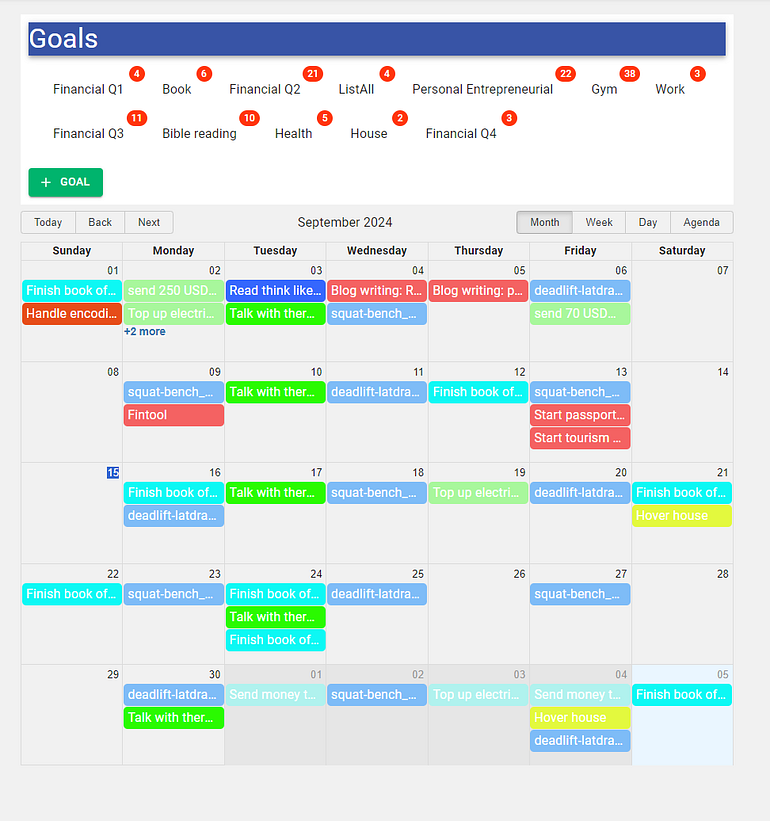
My goals and activities associated to the goals.
Press enter or click to view image in full size
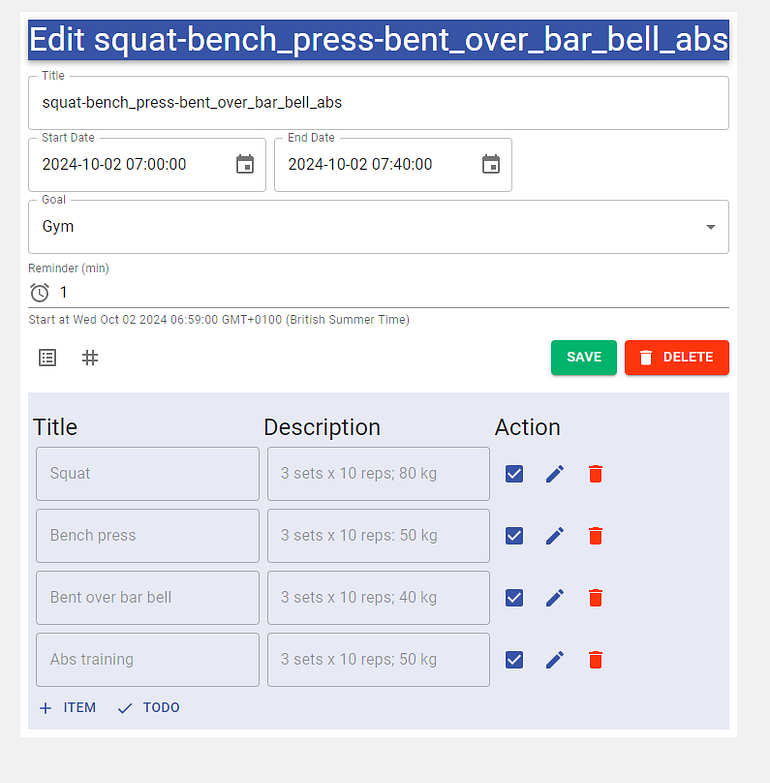
Gym activity with its todo.
The activity above shows that I did squats, bench presses, bent-over barbells, and abs training. An activity with a to-do list is considered complete if all the steps are marked as done.
For work, though, the goals become the people I monitor, and the tasks become the activities. As demonstrated by the example below:
Press enter or click to view image in full size
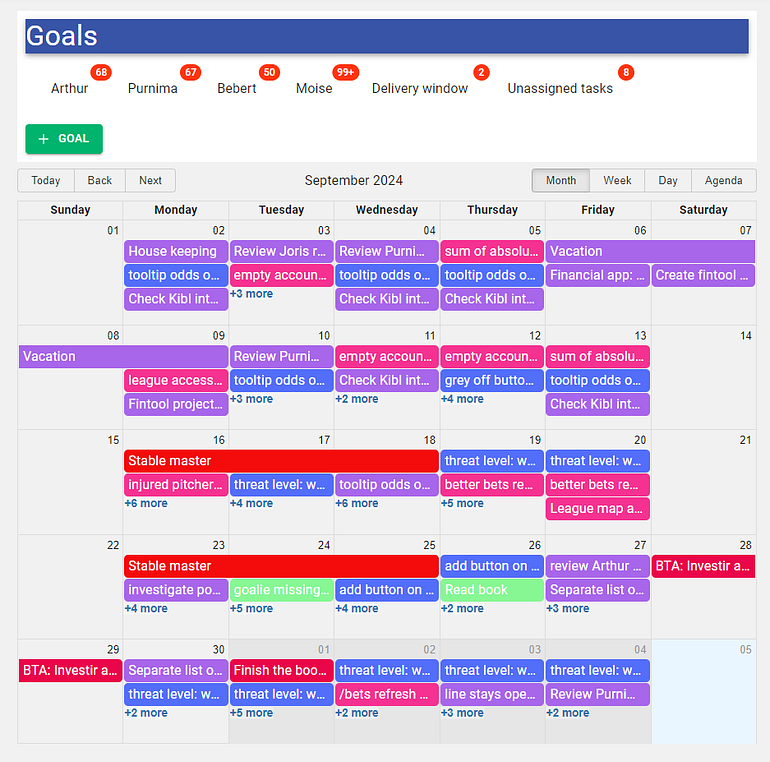
tracking people and myself at work
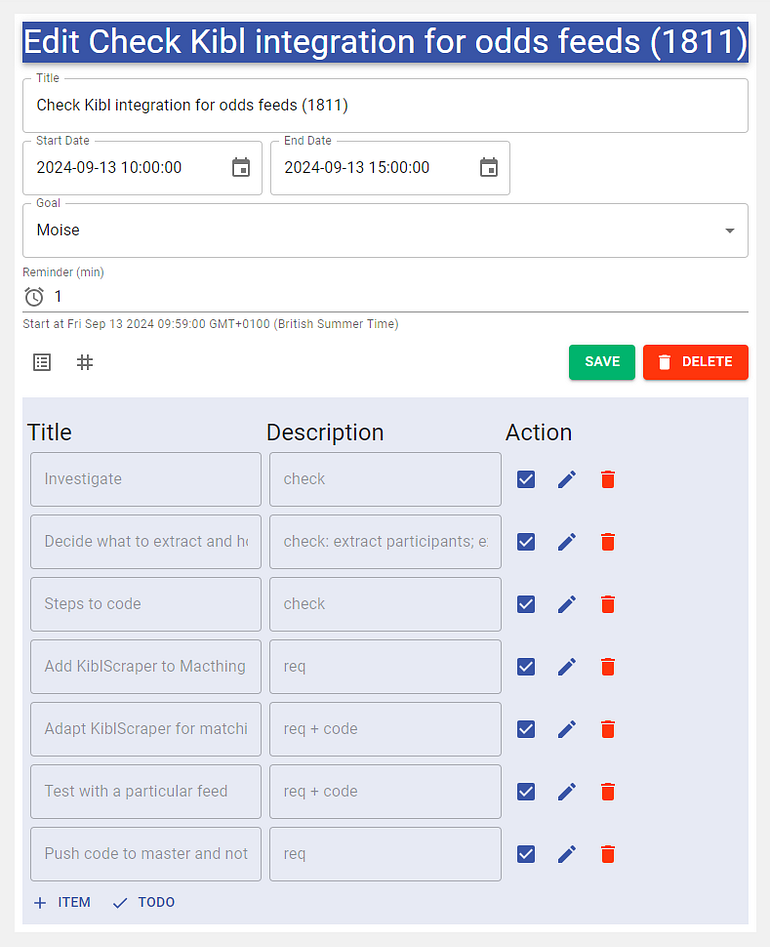
An example of an activity is the following:
Press enter or click to view image in full size
The future
I will add Pomodoro, where the activity is ongoing. For example, work for 25 minutes and take a 5-minute pause. This will be a template for an activity that allows an activity to be created from a Pomodoro template.
Integrate the application with Google Calendar. I want to sync some events from the calendar to the tracker application and vice versa.
I will add a messaging app that integrates ChatGPT, allowing me to share my activities and goals with ChatGPT and get suggestions on the kind of activities to reach my goal.
Conclusion
Despite developing the activity tracker application to track my activities surrounding my goals, I realized that accomplishing my goals through various activities requires the choice to act.
As I use the application, I see it as my track record for evaluating myself and answering the question: What pushes me to act? What is the key to consistency? How much work do I have to put in order not to give up?
The activity tracker application is my super goal, capturing many different goals. What is your super goal?
Let me know if you'd like to try out this application. The more people request it, the more likely I will deploy it online and make it accessible for free.
I leave you with this: set goals that call consistency and persistence. Do an activity where you are doing the minimum things you can do.
Thank you for reading.