Growth Hacker Marketing: Where Science and Entrepreneurship Meet
Reading 'Growth Hacker Marketing' changed how I think about building products. Here are the four steps to turning an MVP into something that markets itself.
21 June 2026
Quote of the day: It takes less time to do something right than to explain why you did it wrong.
Has something you’ve read ever changed how you see the world? Growth Hacker Marketing was probably one of those life-influencing books for me.
The book introduces the notion of Growth Hacker Marketing. This notion is defined as transforming a minimum viable product (MVP, a product with core features that customers want) into a product that markets itself.
The author proposes four steps to reach this self-perpetuating marketing machine: Product Market Fits; Developing Your Growth Hacker; Going Viral; Close the Loop: retention and optimization.
Product Market fits:
The idea is that you want to achieve a product that is market fit before taking it to the next step.
How do you achieve such a market-fit product?
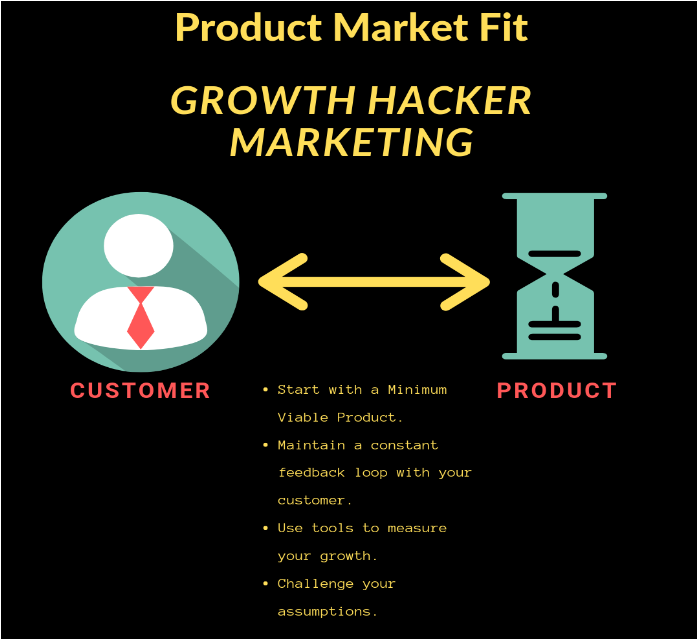
The first step you need to do about your product is to have a minimum viable product. A minimum viable product is a product that has sufficient features to satisfy early adopters.
Now, Product-Market fit is achieved by constantly improving this minimal viable product. The improvement comes about by continuously interacting with your users and getting their feedback regarding your product.
What this means in terms of your product implementation is that it has to be malleable. You need to measure some of your ideas. For example for a typical Android application, you might ask yourself: what are users' feedback regarding the screen color; is it easy to navigate?
The other part of achieving product market fit, which is most important, is understanding your customers. The author suggested using tools such as Google Analytics (I will cover this in a future article), Optimizely, and Kissmetrics, allowing you to see what users respond to.
What are the indicators of a product fit for the market?
The author did not provide an answer to this question, so I went and did a bit of research. What I gather is the following for a product fit for the market:
You have recurring users over many months, not just days and weeks,
It is easy to acquire new users.
Your product is on the news, and many reporters are calling to learn more.
Examples:
As we all know, Instagram did not start as the application we now use. Instead, Instagram was known as Burbn, which had an optional photo feature. But because the founders kept statistics on what users mainly responded to, they realized they were flocking to only one part of the app: the photos and filters. By improving on these features, Instagram soon retooled to become Instagram as we know it.
Airbnb is another example that, when started, was a way for the founders to turn their living room into a bit of bed-and-breakfast.
However, these could have scaled better, but upon further analysis and discussion with potential users, they soon repositioned themselves as a networking alternative for attendees when hotels were booked up.
They kept on iterating based on feedback and usage patterns. They not only improve their product but the name as well, from bed-and-breakfast to Airbnb.
Key takeaways
You need a minimum viable product that should be easily tweaked.
Be open to feedback and constantly improve your minimum viable product
Understand your customers and what they want. Use tools that make it easier for yourself.
Constantly challenge your assumptions regarding your product and users.
I will apply some of these principles to my entrepreneurial activities and keep you posted.