The Psychology of Money, Atomic Habits, and What They Taught Me About Wealth
After reading The Psychology of Money and reflecting on Atomic Habits and Scripture, I realised that wealth is less about financial knowledge and more about behaviour. Our habits, emotions, and character shape our financial future far more than any investment strategy.
27 June 2026
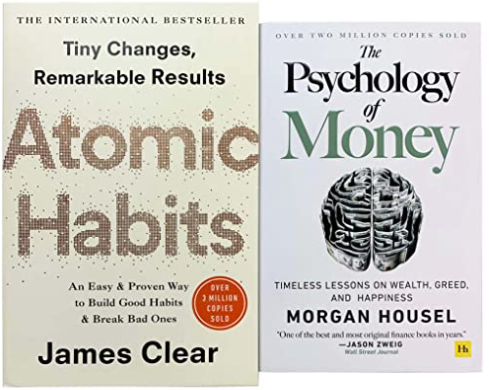
I recently finished reading The Psychology of Money by Morgan Housel and reflected on lessons from Atomic Habits and several passages from Scripture. While the book is often categorised as a finance book, I came away with a different conclusion: money is less about mathematics and more about behaviour.
The way we handle money is often a reflection of who we are. If we are driven by greed, fear, pride, impatience, or insecurity, those same emotions will eventually show themselves in our financial decisions. Money has a way of exposing character.
One lesson that stood out to me was that it is dangerous to judge people solely by their financial circumstances. We rarely know how much of a person's situation was influenced by luck, risk, timing, opportunity, or personal decisions. Two people can make similar choices and experience completely different outcomes because of factors outside their control.
This reminded me that instead of studying successful people, we should often study successful patterns. The goal is not to imitate another person's life. The goal is to understand the principles that allowed them to remain in the game long enough to benefit from opportunities when they arrived.
Ecclesiastes contains a principle that has stayed with me:
Cast your bread upon the waters, for after many days you will find it again.
To me, this speaks about sowing consistently and patiently. Many times I have invested in something because someone else succeeded with it. I assumed that because another person achieved a certain outcome, I would experience the same result. What I failed to see was that I was observing their outcome without understanding their journey, risks, failures, or circumstances.
Another powerful lesson is the relationship between time and compounding. We often focus on skill, but skill alone is not enough. The real power comes when skill is combined with time.
Warren Buffett accumulated most of his wealth after the age of fifty, not because he suddenly became smarter, but because he allowed compounding to work over decades. The same principle applies beyond investing. Our habits compound. Our relationships compound. Our health compounds. Even our spiritual lives compound.
This realisation forced me to ask a difficult question:
What habits am I practising today that are slowly killing my future?
Sometimes the loss of motivation is not caused by a single event. It is caused by small daily actions that gradually weaken our drive and direction.
The book also distinguishes between two different challenges:
Getting wealthy.
Staying wealthy.
Getting wealthy often requires taking risks, working hard, and being willing to pursue opportunities. Staying wealthy requires a completely different set of skills. It requires humility, patience, discipline, and the recognition that everything can be lost.
This lesson struck me personally.
Years ago, I built a taxi business. Looking back, I can see that success affected my thinking. I became proud. I began to believe that my success was entirely the result of my intelligence. Instead of remaining humble and cautious, I became overconfident. Eventually, reality corrected me. Success can be a dangerous teacher if it convinces us that we are invincible.
Another idea that challenged me was the role of tail events. Many successful companies and investors succeed because of a few extraordinary outcomes. Amazon failed in many ventures, yet successes such as AWS and Prime generated enormous value. The lesson is not that every investment will work. The lesson is that a few exceptional outcomes can compensate for many failures.
When I reflect on my own journey, I realise that I often put all my eggs in one basket. Had I understood diversification better, I might have approached things differently. I might have balanced transportation with agriculture, land ownership, livestock, or other income-producing assets.
This thought brings me back to Proverbs 27:
Be sure you know the condition of your flocks, give careful attention to your herds.
The principle is timeless. Wealth is not simply about accumulation. It is about stewardship. We must know the condition of our assets, businesses, skills, and opportunities. Riches do not last forever, and therefore, wise stewardship matters more than temporary success.
Another lesson from the book is that freedom is one of the greatest benefits money can provide.
People often think wealth is about luxury, status, or possessions. Yet what many wealthy people truly value is control over their time. The ability to choose what to work on, where to live, how to spend one's day, and who to spend it with is often more valuable than material possessions.
This shifted my thinking considerably. Perhaps the ultimate purpose of wealth is not consumption but freedom.
The book also challenged my relationship with planning.
For many years, I believed that if I created a good plan and worked hard enough, everything would unfold according to that plan. Experience has shown me otherwise. Life contains uncertainty. Markets change. People change. Circumstances change.
The best financial plans are not those that assume everything will go right.
The best plans are those that prepare for things going wrong.
This realisation explains several failures I have experienced. In my taxi business and in other projects, I often focused on the expected outcome while neglecting potential risks and unexpected events. Going forward, I want to build plans that include room for failure, adaptation, and uncertainty.
One of the most important ideas I took away from the book is that we are often our own greatest obstacle.
Compounding works wonders when left alone, yet many people interrupt it because their emotions change. Fear causes them to sell. Excitement causes them to chase trends. Impatience causes them to abandon long-term plans.
The enemy of compounding is often not the market. It is ourselves.
This connects deeply with what I learned from Atomic Habits. Small actions repeated consistently over time shape our future. Financial success is rarely the result of a single brilliant decision. More often, it is the result of countless small choices repeated over years.
Finally, I came to a conclusion that may be the most important lesson of all.
Money is not primarily a financial issue. It is a behavioural issue.
Our spending reflects our beliefs. Our investments reflect our assumptions. Our savings reflect our priorities. Our financial future is often shaped more by our emotions than by our spreadsheets.
If I want to improve my financial life, I must first examine myself.
What beliefs drive my decisions?
What emotions influence my spending?
What habits am I compounding each day?
These are the questions I now want to explore.
The journey toward wealth is not merely about earning more money. It is about becoming the kind of person who can manage money wisely, steward opportunities faithfully, and remain humble regardless of success or failure.
That, more than any investment strategy, may be the greatest financial lesson I have learned.